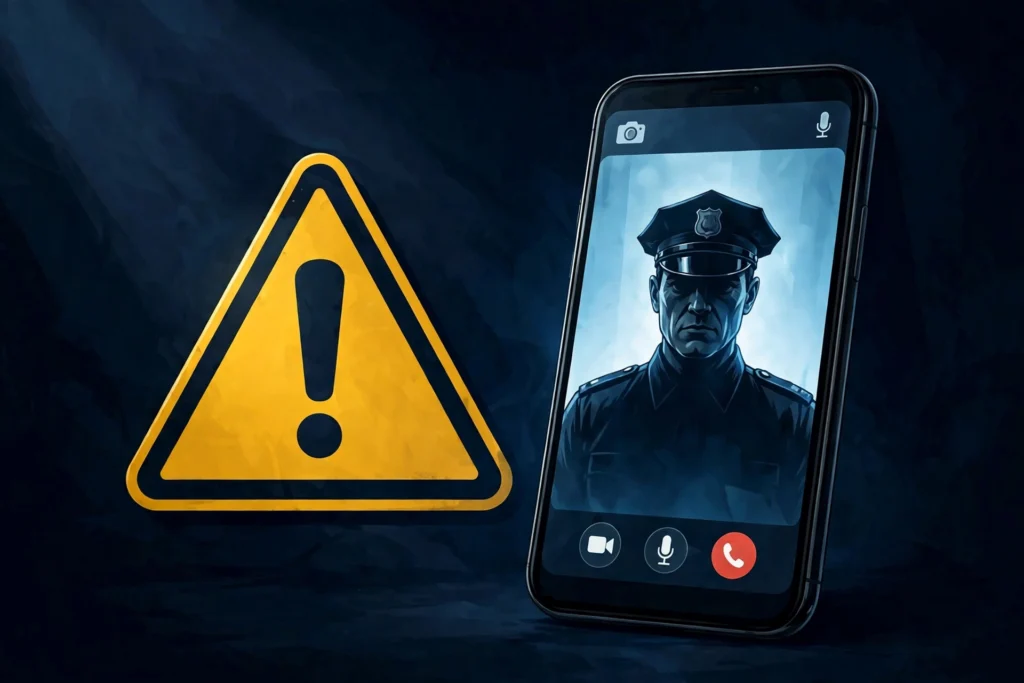
A “digital arrest” scam starts with a frightening call or video call. The caller claims to be a police officer, a customs official, or an officer from an investigation agency. They say you are involved in a crime — money laundering, a parcel containing illegal items, or a case filed against your identity — and that you are now under “digital arrest”. You are told to stay on the call, keep your camera on, and transfer money to “prove your innocence” or “settle the case”.
The truth is simple: there is no such thing as a digital arrest. No police force or government agency arrests people over a video call, and no officer will ever ask you to transfer money to a personal account. If someone on a call tells you that you are under digital arrest, you are talking to a scammer.
How the scam usually starts
The scam often begins with an ordinary phone call. The caller may say they are from the police, the customs department, a courier company, or an investigation agency.
The caller usually knows something about you. They may say your full name, your address, or parts of your identity document details. Hearing your own details from a stranger is frightening, and that fear is exactly what the scammer wants.
Then comes the accusation. The caller says a parcel in your name was found with illegal items, or your bank account was used for money laundering, or a case has been filed against you. They say the matter is serious and urgent.
The script, step by step
Once you are frightened, the scammer follows a script. Knowing the script in advance takes away much of its power.
First, they create urgency. They say you must act now, or the police will come to your home, or your bank accounts will be frozen. Urgency is the main weapon of this scam.
Second, they demand secrecy. They tell you not to tell your family, not to call anyone, and not to hang up. This is a lie. The real reason they want secrecy is that a family member would immediately recognise the scam and tell you to hang up.
Third, they show fake proof. On a video call, they may show a fake identity card, a uniform, or official-looking documents on camera. These are easy to fake. A document shown on a screen can be made on any computer. Never accept something shown on a video call as proof of authority.
Fourth, they ask for money. They say you must transfer money to a “safe account” to prove your innocence, or pay a fine to settle the case, or deposit a security amount that will be refunded later. They may give you an account number or a wallet number and stay on the call while you transfer the money. Then they disappear.
Why this scam works
Digital arrest scams work because they attack the emotions that make clear thinking difficult. Fear is the strongest of these. When someone in authority tells you that you are in serious trouble, your first reaction is panic, not doubt. The scammer counts on that panic.
Authority is the second factor. Most people have been taught to respect the police and to cooperate with officials. The scammer borrows that respect by pretending to be an officer. A uniform, a serious tone, and official-sounding words are enough to make many people obey without question.
Isolation is the third factor. By keeping you on the call and telling you not to speak to anyone, the scammer removes the one thing that would stop the scam: a second opinion. Almost every victim who later describes the experience says the same thing — as soon as they spoke to a family member, the trick became obvious. The scammer knows this, which is why secrecy is always part of the script.
Who is targeted
Anyone can receive one of these calls, but scammers often target people who are less familiar with online fraud. Elderly people are a common target, because they may be more trusting of authority and less likely to question a caller who sounds official. People living alone are also targeted, because there is nobody nearby to interrupt the call.
Students and workers have been targeted with the same script, often with the added threat that their studies or their job will be affected. The scam does not depend on who you are. It depends on catching you at a moment when you are alone, frightened, and unable to check the facts.
What real police do — and do not do
It helps to know the difference between a real investigation and this scam. Real police do not arrest people over a phone call or a video call. An arrest is a physical act, carried out in person, with proper legal process. No officer will tell you that you are arrested while you sit at home on a video call.
Real officers do not ask you to transfer money to a personal account or a wallet number. Fines and legal payments are never collected by an officer over the phone. If you ever owe a genuine fine, it is handled through a formal written notice and an official payment channel, not through a call demanding an immediate transfer.
Real officers do not ask you to keep the matter secret from your family. They do not ask you to stay on a video call for hours with your camera on. They do not send you a case number on a messaging app and demand money in the same conversation. If a call includes any of these demands, it is a scam, no matter how official the caller sounds.
What to do during the call
If you receive a call like this, the best action is the simplest one: hang up immediately. Do not argue with the caller. Do not try to prove your innocence. Do not answer their questions. Just end the call.
Do not transfer any money, and do not share your bank details, OTPs, passwords, or identity documents. Do not keep your camera on, and do not follow instructions to move to another room or download any app. The caller has no power over you once you hang up.
If the caller calls back, do not answer. If they send messages with threats, do not reply. Save the number and the messages as evidence, but do not engage with the scammer.
What to do after the call
After you hang up, take a few minutes to calm down, and then tell someone in your family what happened. Talking about it is the best protection. A family member can confirm that it was a scam and help you take the next steps.
If you shared any passwords or codes, change them right away. If you sent money, contact your bank and your wallet service immediately and explain what happened, and report the matter to the official cybercrime helpline. Keep the number, the messages, and any payment receipts as records.
You can also search the number on ScamCheckerOnline for free to see whether other users have already reported it. If you want to file a report yourself, you can create a free account and submit one. Every report is reviewed by our team before it is published. A report is an allegation made by a user, not a confirmed verdict, and the identity of the person who reports is never shown publicly.
How to protect your family
The best defence against this scam is a conversation before it happens. Tell your parents, grandparents, and elderly relatives about digital arrest scams in simple words. Explain that no police officer will ever arrest someone over a video call, and that no officer will ever ask for money on a call. Make sure they know the one rule that defeats the scam: hang up, and call a family member.
Agree on a simple family rule. If anyone receives a frightening call from someone claiming to be an officer, the first step is to hang up and call a trusted family member. No exception. Practice this rule the way you would practice any safety habit, so that it is ready in a moment of panic.
It also helps to check in with elderly relatives regularly. Scammers often call at times when a person is alone at home.
Final Thoughts
Digital arrest is a made-up threat used by criminals to steal money through fear. The uniform is fake, the documents are fake, the case number is fake, and the danger is fake. The only real thing in the call is the scammer’s demand for money.
Remember the three rules. There is no such thing as a digital arrest. No officer asks for money on a call. And secrecy is always a sign of a scam. If you remember these three things, and you tell your family about them, this scam loses its power.
If a number used in a digital arrest scam contacted you, reporting it can help protect the next person. Search the number, file a report if you can, and warn your family and friends. The more people who know this trick, the fewer victims it will find.